Encryption is not the place for brand loyalty. In PHP, the real decision is operational: what can your stack support cleanly, what can your team maintain, and what format will still make sense during the next key rotation instead of becoming a small archaeological dig.
Developers usually arrive here with a practical cluster of questions. Do I need encryption at all, or only hashing or encoding? If I do need reversible protection, is AES-256 the default answer or is SERPENT worth the extra work? Where do keys live, how do IVs or nonces travel, and how do I rotate anything without breaking existing records?
For broader planning context, teams can compare guidance from web.dev guidance before choosing a workflow.
The short answer is reassuringly boring. Most PHP teams should choose AES-256 when they need application-level encryption, because it is widely available through OpenSSL, easier to integrate, easier to review, and easier to hand over to the next person on call. SERPENT is a valid algorithm, but in normal PHP operations it is more often a compatibility decision than a productivity decision.
This guide is built to help you make that choice with fewer myths and fewer expensive shortcuts. We will cover when encryption is the right tool, how AES-256 and SERPENT differ in practice, how to handle keys and IVs safely, what a durable payload format looks like, and what to test before you trust the result. For related site resources, start from the home page, the main blog, the Sources/Functions… section, and Support.
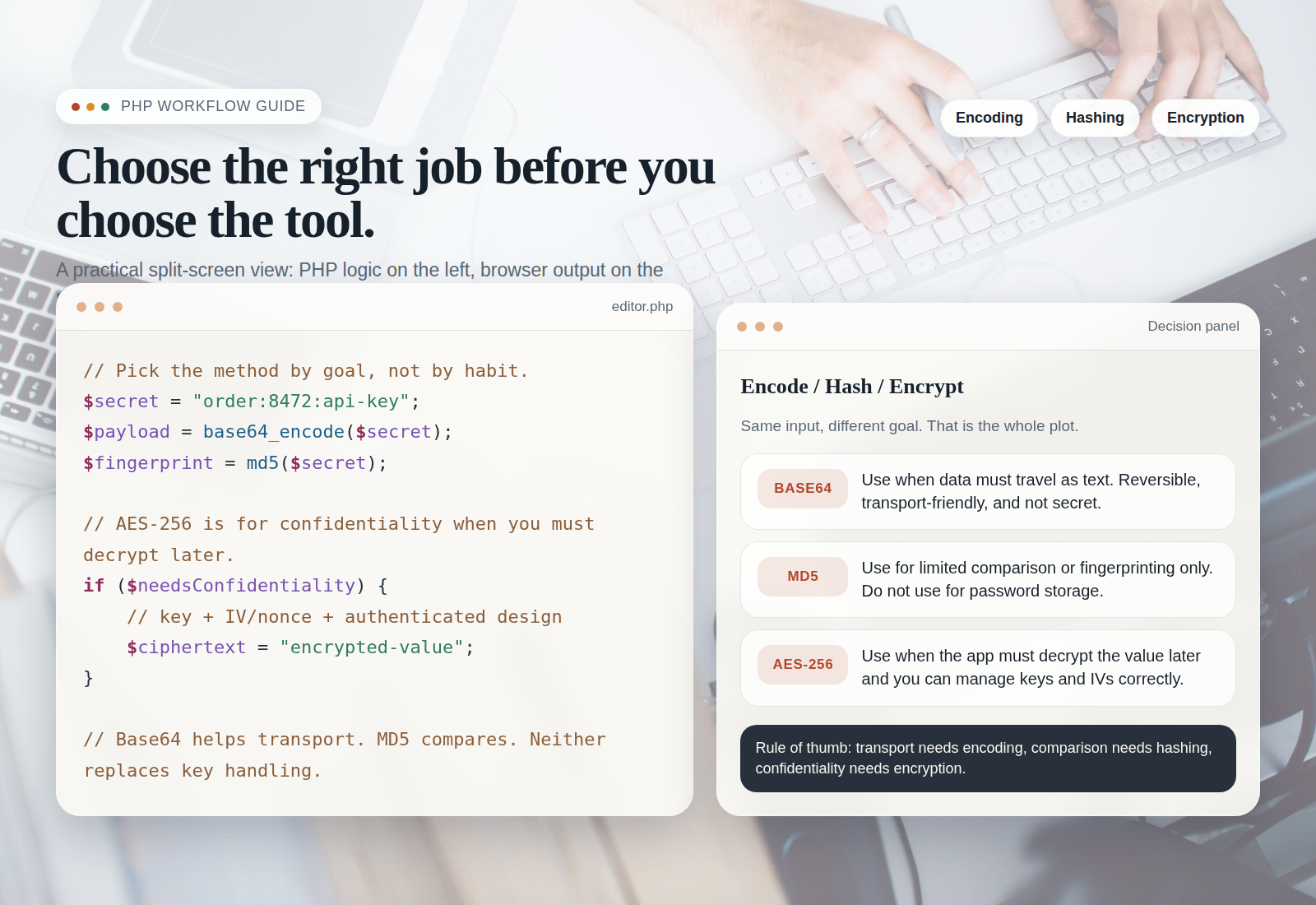
When you actually need encryption
Before comparing algorithms, define the job. Developers waste a lot of time debating crypto names when the workload only needed a safer category decision.
Related implementation details are also covered in MDN Web Docs, which helps keep tool decisions grounded in established practices.
| Need | Use this | Why | Do not confuse it with |
|---|---|---|---|
| Recover the original value later | Encryption | The application must decrypt data for a valid business workflow | Base64 or one-way hashing |
| Verify a password or compare a value without reading it back | Hashing | You want one-way comparison, not reversible storage | Encryption with a shared key |
| Make data easier to transport through text-only channels | Encoding | You are changing representation, not adding secrecy | Real confidentiality controls |
Encrypt only when you have a business reason to decrypt. Typical cases include API credentials the application must use, customer data that must be revealed to an authorized workflow, or stored configuration secrets. If nobody should ever recover the original value, encryption is usually the wrong category.
That distinction matters because encryption creates ongoing obligations: key storage, key rotation, payload versioning, tamper handling, and migration paths. Those costs are manageable, but they are not optional. Security design has a habit of sending the invoice later.
AES-256 vs SERPENT: what matters in real PHP projects
AES-256 and SERPENT are both block ciphers. That fact alone does not make them equally practical in PHP. For most teams, the decision comes down to availability, library support, interoperability, and the operational cost of carrying the choice forward.
| Decision point | AES-256 | SERPENT |
|---|---|---|
| Default availability in PHP environments | Common through OpenSSL-backed workflows | Usually requires a narrower library choice or a legacy-specific dependency |
| Team familiarity | Higher, especially across hosting providers and security reviews | Lower, which raises maintenance and handoff cost |
| Interoperability with other systems | Generally easier when another service, platform, or vendor expects a mainstream implementation | Usually appropriate only when an existing protocol or inherited system already chose it |
| Operational recommendation | Best default for new PHP application encryption | Reasonable for compatibility work, not usually the first choice for greenfield builds |
Choose AES-256 when you are building a new PHP workflow and you control the implementation. That path gives you better tooling, easier deployment, and fewer surprises during code review. It is not glamorous, which is one of its better qualities.
Choose SERPENT only when you have a clear compatibility reason. For example, you may be reading payloads from a legacy component, matching an inherited data format, or maintaining an older integration where the algorithm choice is already part of the contract. In that case, the responsible move is to isolate the scope, document it, and avoid pretending it is a general recommendation.
Compliance and policy constraints matter too, but this is the practical rule: if a customer, auditor, partner, or internal standard explicitly names AES-based handling, do not get creative. If an existing business dependency already mandates SERPENT for a narrow workflow, honor that dependency and contain it. The question is not which algorithm wins a debate on a whiteboard; the question is which choice leaves your system legible and supportable.
If you review older crypto-related site pages, the legacy references for Encrypt / Decrypt AES-256 and Encrypt / Decrypt SERPENT are useful orientation points, but production implementation should still center on current library support and safe operating procedures.
Key management basics: decide where the real secret lives
Most encryption failures are not failures of AES or SERPENT. They are failures of key handling. If the key sits in the repository, in a copied configuration file, in logs, or in an over-permissive admin panel, the algorithm discussion is mostly theatre.
For a PHP application, use a simple hierarchy:
- Generate keys with a cryptographically secure source. Do not improvise with passwords, timestamps, or human-readable phrases.
- Store keys outside the codebase. Environment-backed secrets, a dedicated secret store, or a tightly controlled deployment secret is the normal path.
- Separate key identity from ciphertext. Your payload should know which key version was used without exposing the key itself.
- Limit access aggressively. The number of people and processes that can read the encryption key should be smaller than the number who can deploy the app.
A practical pattern is to assign each active key a version label such as k1, k2, or a date-based identifier. New writes use the current key. Reads inspect the payload, determine the key version, decrypt with the right key, and optionally re-encrypt with the newer key during a controlled migration.
Rotation should not break reads. That means you do not replace a key and hope for the best. You add a new write key, keep the previous read keys available during migration, and retire old keys only after the related payloads have been reprocessed or expired. The right process is less dramatic than the wrong outage.
If your team is building internal admin tooling around secrets, a web app generator can speed up scaffolding for forms and dashboards, but it does not reduce the need for a clear key ownership model, least-privilege access, or a documented rotation runbook.
IV and nonce handling: why repeated plaintext can betray you
Encryption modes require more than a key. They also require a fresh initialization value, commonly an IV or nonce depending on the mode. The operational rule is straightforward: do not reuse the same key and IV or nonce combination in a way your chosen construction forbids.
If you encrypt the same plaintext twice with unsafe repetition, patterns can leak. That is exactly the sort of leak developers do not notice during happy-path testing because every test fixture looks unique and cooperative. Real data is less polite.
For day-to-day PHP work, keep these rules in view:
- Generate a fresh IV or nonce for each encryption operation.
- Store or transmit that IV or nonce with the ciphertext. It is not usually a secret; it is metadata required for decryption.
- Do not invent your own reuse policy. Follow the expectations of the encryption mode and the library you selected.
- Never treat repeated outputs as “proof it works.” Good tests confirm correctness and distinctness where distinctness is expected.
This is also why ECB mode remains a bad idea for application data. ECB turns repeated structure into visible structure. That may be technically concise and operationally unhelpful, which is my polite version.
Recommended output format: design for future you
The ciphertext itself is only part of the payload. A durable encrypted value should include enough metadata to decrypt safely later, rotate keys cleanly, and diagnose version problems without guesswork.
A practical application-level format often looks like this:
v1.k2.aes-256-gcm.<base64url-iv>.<base64url-ciphertext>.<base64url-tag>The exact delimiters are less important than the structure. The payload should communicate:
- Version: lets you change formats later without breaking the parser.
- Key identifier: tells the reader which configured key should be used.
- Algorithm or mode marker: useful when legacy compatibility forces more than one path.
- IV or nonce: required for decryption.
- Ciphertext: the protected data.
- Authentication tag or MAC material: required when the design includes tamper detection.
Base64 or Base64URL belongs at the transport edge, not as a substitute for encryption. Use it because binary ciphertext and tags are awkward in JSON, URLs, logs, and database fields. Do not use it because it “looks secure.” Many expensive misunderstandings start with that phrase.
Versioned payloads also make backward compatibility survivable. If you need to move from one mode to another, introduce a stronger authenticated format, or retire a SERPENT compatibility branch later, the parser can route each record cleanly instead of forcing an all-at-once migration.
PHP implementation checklist
For most new projects, the recommendation is simple: use OpenSSL-backed AES in a reviewed, authenticated design and keep the implementation surface small.
For AES-based workflows
- Use a supported OpenSSL cipher and confirm the expected key size and IV length in code.
- Generate keys and IVs from a secure random source.
- Store keys outside the repository and outside user-editable settings where practical.
- Prefer an authenticated mode or an explicit design that includes tamper detection.
- Build a single encryption service class or module instead of scattering crypto calls across controllers and helpers.
For SERPENT-based workflows
- Confirm that the exact library and mode support are available in the deployment environment before promising anything.
- Document the compatibility reason in the code and the runbook.
- Keep the SERPENT branch isolated so it does not become the accidental default for unrelated data.
- Plan an exit path if the algorithm support depends on a fragile extension or unmaintained dependency.
If you need a general operating view of how values move through systems, the site’s Reports & Tracking section is a useful companion because encryption choices affect storage, observability, and troubleshooting just as much as they affect code.
Recommended rollout sequence for a live PHP system
The safest encryption rollout is staged, not theatrical. If you are adding application-level encryption to an existing system, use a sequence that protects reads first and cleans up writes second.
- Inventory the fields that truly require confidentiality. Do not encrypt entire tables because the word “sensitive” appeared in a meeting.
- Define one payload format and one parser. Consistency matters more than cleverness.
- Ship read support before bulk migration. Your application should be able to recognize the new versioned format without forcing immediate conversion.
- Start writing new records with the new format. From that point forward, the system stops creating more migration debt.
- Migrate old rows in controlled batches. Measure failures, log identifiers safely, and keep rollback simple.
- Retire legacy code only after fixture-based verification. If you cannot prove old and new records both read correctly, you are not done.
This sequence matters just as much when SERPENT is involved. If you are preserving a SERPENT branch for compatibility, keep it behind an explicit version marker and remove any temptation to reuse it for unrelated new data. Compatibility code has a way of becoming permanent the moment nobody assigns ownership.
Common mistakes to avoid
- Using ECB mode. It is the classic way to produce ciphertext that still leaks structure.
- Hardcoding keys in source control. A secret copied into code is no longer being managed; it is being misplaced.
- Skipping authentication. Encryption without tamper detection is incomplete for many application cases.
- Reusing IVs or nonces carelessly. Distinct operations need distinct supporting values where the mode requires it.
- Mixing encoding and encryption. Base64 can package ciphertext, but it does not create confidentiality.
- Logging sensitive material. Encrypted blobs, plaintext before encryption, and failed decrypt payloads all deserve tighter logging rules.
- Building algorithm choices into public API assumptions too early. Prefer versioned wrappers so you can migrate later.
Another avoidable mistake is pretending library availability is a minor detail. It is not. In PHP, the algorithm you can deploy, test, review, and rotate cleanly is almost always better than the algorithm you admire from a distance.
Testing strategy: prove more than the happy path
Crypto tests should answer three operational questions: Can I decrypt what I encrypt? Can I detect tampering when the design says I should? Can I still read older payload versions after the code changes?
A minimal but serious test set includes:
- Round-trip tests: encrypt then decrypt representative values, including empty strings, Unicode text, long payloads, and serialized application fields.
- Distinct output tests: encrypt the same plaintext twice and confirm the outputs differ when the mode and IV policy require that behavior.
- Tamper tests: mutate the ciphertext, IV, or authentication tag and confirm the decrypt step fails safely.
- Backward compatibility tests: keep fixtures for older payload versions and older key identifiers.
- Failure logging tests: make sure operational logs record enough to diagnose a problem without leaking secrets.
For teams with small engineering bandwidth, this is the sensible rule: freeze sample fixtures before a key rotation or format change. Those fixtures give you proof that old records will still read correctly after the migration. Without them, every release becomes a confidence exercise, and confidence is not a control.
A simple decision sequence for developers under deadline
When time is short, use this sequence instead of reopening the entire crypto debate:
- Ask whether the app must recover the original value. If not, stop and re-evaluate whether encryption belongs here at all.
- If recovery is required, default to AES-256 unless a hard compatibility constraint already points elsewhere.
- Choose a mode and payload format that include tamper awareness, versioning, and a transport-safe wrapper.
- Assign key ownership before coding the storage layer. A finished helper with no key process is not finished.
- Write the backward-compatibility tests before rotation or migration work begins.
That sequence is not mathematically exciting, but it is operationally honest. In production systems, honest usually wins.
Quick recommendation matrix
| Scenario | Recommended path | Why |
|---|---|---|
| New PHP app storing decryptable secrets | AES-256 in a reviewed authenticated design | Best balance of support, maintainability, and interoperability |
| Legacy system already committed to SERPENT | Keep SERPENT only for that compatibility boundary | Reduces migration risk while avoiding unnecessary spread |
| Password storage | Do not use reversible encryption | Password verification belongs in a password-hashing workflow |
| Binary ciphertext moving through JSON or URLs | Encrypt first, then encode for transport | Encoding packages the payload; it does not protect it |
| Key rotation project | Add a new write key and keep old read keys during migration | Prevents breaking existing records |
Choose this if…
Choose AES-256 if: you are building new functionality, you need straightforward PHP integration, you expect other systems or reviewers to understand the implementation quickly, and you want the least operational friction.
Choose SERPENT if: you are honoring a legacy contract, you have verified library support, and you are disciplined enough to keep the choice contained to that requirement instead of letting it spread by inertia.
Choose neither if: the real need is password verification, checksum-style comparison, or transport formatting. In those cases, encryption is solving the wrong problem and adding cost without adding clarity.
Final recommendation
For real-world PHP data protection, the default business case is clear: use AES-256 for new reversible encryption workflows, reserve SERPENT for explicit compatibility cases, and spend the bulk of your attention on keys, IVs, authenticated payload design, and test coverage.
That is the decision that usually survives contact with deployment, maintenance, and incident response. If you want help auditing a current implementation or narrowing an inherited crypto workflow into something supportable, use Support. The priority is not sounding sophisticated. The priority is being able to read, rotate, and defend the system later.