Why referrer and source analytics break in real traffic
Referrer and source data look simple until they meet production traffic. Missing headers, bot traffic, redirect chains, and malformed URLs can turn a clean dashboard into a pile of false certainty. The right response is not more collection. It is stricter acceptance criteria.
Use a privacy-first rule: accept only the minimum source signals that help answer a business question, and reject everything else. That keeps the system easier to audit and less attractive as a shadow data store.
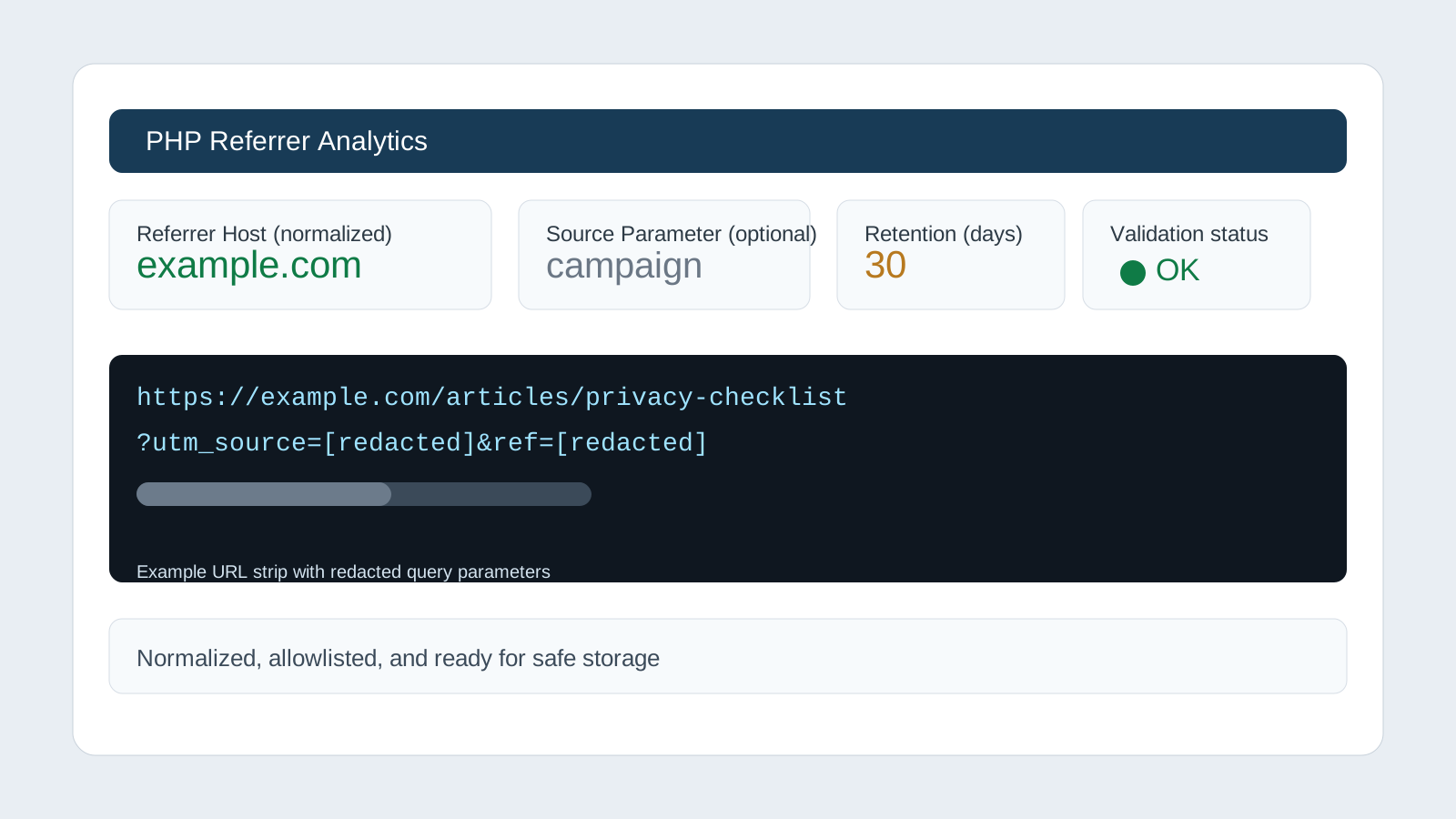
Definition: In this checklist, referrer analytics means reading the HTTP Referer header or a source parameter to understand where a visit came from. Source analytics means the broader workflow around storing, classifying, and reporting that data.
Data minimization rules
Start with a narrow schema. If you do not need a full URL, do not store one. If you only need the referring domain, store the canonical host and nothing more. If campaign attribution is optional, make it opt-in at the field level, not as a permanent default.
- Collect: normalized host, optional path bucket, timestamp, and a coarse source label.
- Drop: raw query strings, fragments, user identifiers, and anything that looks like a secret.
- Retain: the shortest period that still supports reporting, trend analysis, and debugging.
A practical default is to keep detailed source records for a short window and aggregate summaries after that. If you need guidance on reporting cadence, compare your analytics needs with the structure used on Reports & Tracking and the operational notes in Sources/Functions.
Header handling basics
Read headers as untrusted input. A browser-provided referrer is useful, but it is not a promise. Proxies, privacy tools, and browsers with stricter defaults may strip it entirely. Bots may send odd values or none at all. Treat absence as normal, not exceptional.
For reference, the MDN documentation on the Referer header explains why it is often omitted or reduced. The privacy guidance in OWASP’s Referer header notes is also worth a careful read.
Checklist:
- Read the header once, then copy it into a local variable.
- Check that the value is a string before parsing.
- Reject obviously malformed inputs early.
- Never use the raw header directly in HTML, logs, or SQL.
Normalization steps
Normalization should make the data more comparable, not more detailed. Trim whitespace, lower-case the host, remove default ports, and canonicalize the scheme. If tracking parameters are not needed, strip them before storage. This reduces duplicate rows such as Example.com and example.com appearing as different sources.
| Input | Normalized output | Reason |
|---|---|---|
https://Example.com:443/path?utm_source=x |
https://example.com/path |
Stable host comparison and less noise |
http://news.example.com/article?id=7&ref=mail |
http://news.example.com/article |
Campaign parameters removed where appropriate |
When you remove parameters, write the rule down. Otherwise the team will argue with the database later, which is a hobby nobody needs.
Validation and allowlisting
Accept only the schemes and hosts you expect. If your workflow is intended for HTTP and HTTPS URLs from known public sources, do not quietly accept file paths, javascript pseudo-URLs, or internal hostnames.
- Allowlist:
httpandhttpsonly, if that matches your use case. - Host rules: accept known partner domains or your own properties when relevant.
- Reject: empty values, non-URL strings, embedded credentials, and unsupported schemes.
PHP’s filter_var() is a reasonable first pass, but it is not a full policy engine. Use it for validation, then apply your own host and path rules.
Safe parsing approach
Parse the URL only after it passes basic validation. In PHP, parse_url() can split host, path, and query components without executing anything. That is the point. You want data extraction, not interpretation.
$referrer = trim($input);
if (!filter_var($referrer, FILTER_VALIDATE_URL)) {
    return null;
}
$parts = parse_url($referrer);
$host = strtolower($parts['host'] ?? '');
$path = $parts['path'] ?? '/';
Do not reflect the original value back into a page or debug panel without escaping. Output encoding belongs at the final display step, not somewhere in the middle where it can be forgotten.
Storage design
Store canonicalized values. Avoid raw URLs unless you have a clear operational reason and a short retention rule. Use parameterized queries for every write path, including the ones you think are “internal.” Internal code is where people tend to become cheerful and careless.
- Separate event storage from summary tables.
- Store the normalized host, a coarse source bucket, and a retention timestamp.
- Keep raw payloads out of long-lived tables.
If you are building a tracker for a PHP application, the workflow should fit cleanly alongside the existing RedKernel Referer Tracker page and the broader reporting flow.
Security checklist
Analytics endpoints are still endpoints. Protect them accordingly.
- CSRF: require a token for any state-changing admin action, even if the form only updates settings.
- Rate limiting: throttle collection and admin exports to reduce abuse and log flooding.
- XSS: escape all output, especially source labels and hostnames shown in tables.
- Logging: avoid dumping raw query strings into application logs.
For a broader PHP security baseline, OWASP Top 10 remains a sensible checklist to keep nearby.
Privacy and compliance readiness
Design the system so privacy settings can change without a schema rewrite. That means consent-aware toggles, anonymization options, and a public description of what you collect and why. It also means giving support staff a clear answer when users ask what the tracker stores.
Useful defaults
- Source tracking off until enabled.
- IP addresses truncated or omitted from analytics tables.
- Short retention for detailed records.
- Plain-language documentation in the support area.
Tradeoffs to watch
- More anonymization means less debugging detail.
- Tighter allowlists reduce noise but may hide legitimate edge cases.
- Short retention lowers privacy risk but weakens long-range trend analysis.
Keep the explanation visible on your Support page and point readers to the site’s home page for general navigation. If you maintain a publishing rhythm, the blog index should remain the public entry point for related articles.
Decision summary
The safest reasonable default is simple: collect less, normalize early, validate strictly, store canonicalized values, and expose only the minimum useful view to users. That approach gives you cleaner data and fewer privacy surprises. It is not glamorous, which is often how the better design starts.
Practical next step: choose one source field, one retention period, and one allowlist policy, then document them before you expand the feature set.